
When should you test? You can take most home pregnancy tests three to four days before your missed period — but if you test too early, you’re more likely to get a false negative, where the test says you’re not pregnant but you really are, says Laurence Cole, MD, professor of obstetrics and gynecology and chief of women’s health research at the University of New Mexico in Albuquerque. Whichever test you buy, test first thing in the morning, pop the stick in midstream, lay it flat, and give it a few minutes to work. If it’s negative, try again in a few days if your period’s still MIA. If you get a faint, is-that-what-I-think-it-is positive, chances are you’re indeed pregnant. Wait a day or two and test again. And if it’s positive.

In Nepal also the demand of toys are high. In the shop of Kathmandu. Toys are available worth Rs 1500 to Rs42000. The thin lubricant condoms are also available in the shop and this is the most demanded condom in Nepali market by male. Toys can be an exciting way to spice up sexual life, whether using them by ourselves or with others. There are many misconceptions that toys are only used by people who choose to remain abstinent, do not currently have partners, or by gay men and lesbians. The truth is, people of all types use toys. Some choose to use them when they are alone, on their partners, or on themselves while partners are present. Toys can range from objects that tickle and vibrate, to various products that are inserted into the vagina or anus. Some examples of toys are vibrators, feathers, dildos, harnesses, butt plugs, cock rings, and anal beads.
Watch video from HERE.
Watch video from HERE.
In modern usage, a missile is a self-propelled precision-guided munition system, as opposed to an unguided self-propelled munition, referred to as a rocket (although these too can also be guided). Missiles have four system components: targeting and/or missile guidance, flight system, engine, and warhead. Missiles come in types adapted for different purposes: surface-to-surface and air-to-surface missiles (ballistic, cruise, anti-ship, anti-tank, etc.), surface-to-air missiles (and anti-ballistic), air-to-air missiles, and anti-satellite weapons. All known existing missiles are designed to be propelled during powered flight by chemical reactions inside a rocket engine, jet engine, or other type of engine.[citation needed] Non-self-propelled airborne explosive devices are generally referred to as shells and usually have a shorter range than missiles.
In ordinary British-English usage predating guided weapons, a missile is “any thrown object”, such as objects thrown at players by rowdy spectators at a sporting event.This section does not cite any references (sources). Please help improve this section by adding citations to reliable sources. Unsourced material may be challenged and removed. (June 2013)
The word missile comes from the Latin verb mittere, meaning “to send”.
In ordinary British-English usage predating guided weapons, a missile is “any thrown object”, such as objects thrown at players by rowdy spectators at a sporting event.This section does not cite any references (sources). Please help improve this section by adding citations to reliable sources. Unsourced material may be challenged and removed. (June 2013)
The word missile comes from the Latin verb mittere, meaning “to send”.
Yamaha India will finally introduce the YZF-R3 on August 11, 2015, which will take on rivals KTM RC390 and the Kawasaki Ninja 300. While on performance the Benelli TNT 300 is also a worthy rival, it has not been included in this comparison as its a naked motorcycle, whereas the bikes here are fully-faired.
Starting with the engine, the KTM RC390 has the highest displacement, despite being a single-cylinder unit. The Yamaha R3 and the Ninja 300 feature twin-cylinder engines displacing 321 cc and 296 cc respectively. On paper, these motorcycles produce power in the whereabouts of 39-43 PS, though the RC390 develops its maximum power and torque earlier in its rev-range.
The RC390 also has the highest power-weight ratio in its class at 262.04 PS/tonne, while the Ninja puts the lowest figure of 226.74 PS/tonne. Courtesy of the RC390’s performance credentials is its lightest weight in class of only 166 kg.
All motorcycles get similar disc brakes at the front and rear, and ABS is expected to be offered on the R3 as well. However, the RC390 gets wider Metzeler tyres at the back in comparison.
Prices of the Yamaha R3 will be announced on August 11, though according to reports, it will be imported through the CKD route from Indonesia, indicating that prices may not be as aggressive as the locally manufactured KTM.

Starting with the engine, the KTM RC390 has the highest displacement, despite being a single-cylinder unit. The Yamaha R3 and the Ninja 300 feature twin-cylinder engines displacing 321 cc and 296 cc respectively. On paper, these motorcycles produce power in the whereabouts of 39-43 PS, though the RC390 develops its maximum power and torque earlier in its rev-range.
The RC390 also has the highest power-weight ratio in its class at 262.04 PS/tonne, while the Ninja puts the lowest figure of 226.74 PS/tonne. Courtesy of the RC390’s performance credentials is its lightest weight in class of only 166 kg.
All motorcycles get similar disc brakes at the front and rear, and ABS is expected to be offered on the R3 as well. However, the RC390 gets wider Metzeler tyres at the back in comparison.
Prices of the Yamaha R3 will be announced on August 11, though according to reports, it will be imported through the CKD route from Indonesia, indicating that prices may not be as aggressive as the locally manufactured KTM.
Radiofrequency energy is a form of electromagnetic radiation. Electromagnetic radiation can be categorized into two types: ionizing (e.g., x-rays, radon, and cosmic rays) and non-ionizing (e.g., radiofrequency and extremely low frequency, or power frequency). Electromagnetic radiation is defined according to its wavelength and frequency, which is the number of cycles of a wave that pass a reference point per second. Electromagnetic frequencies are described in units called hertz (Hz).
The energy of electromagnetic radiation is determined by its frequency; ionizing radiation is high frequency, and therefore high energy, whereas non-ionizing radiation is low frequency, and therefore low energy. More information about ionizing radiation can be found on the Radiation page.
The frequency of radiofrequency electromagnetic radiation ranges from 30 kilohertz (30 kHz, or 30,000 Hz) to 300 gigahertz (300 GHz, or 300 billion Hz). Electromagnetic fields in the radiofrequency range are used for telecommunications applications, including cell phones, televisions, and radio transmissions. The human body absorbs energy from devices that emit radiofrequency electromagnetic radiation. The dose of the absorbed energy is estimated using a measure called the specific absorption rate (SAR), which is expressed in watts per kilogram of body weight.
Exposure to ionizing radiation, such as from x-rays, is known to increase the risk of cancer. However, although many studies have examined the potential health effects of non-ionizing radiation from radar, microwave ovens, cell phones, and other sources, there is currently no consistent evidence that non-ionizing radiation increases cancer risk (1).
The only consistently recognized biological effect of radiofrequency energy is heating. The ability of microwave ovens to heat food is one example of this effect of radiofrequency energy. Radiofrequency exposure from cell phone use does cause heating to the area of the body where a cell phone or other device is held (ear, head, etc.). However, it is not sufficient to measurably increase body temperature, and there are no other clearly established effects on the body from radiofrequency energy.
The energy of electromagnetic radiation is determined by its frequency; ionizing radiation is high frequency, and therefore high energy, whereas non-ionizing radiation is low frequency, and therefore low energy. More information about ionizing radiation can be found on the Radiation page.
The frequency of radiofrequency electromagnetic radiation ranges from 30 kilohertz (30 kHz, or 30,000 Hz) to 300 gigahertz (300 GHz, or 300 billion Hz). Electromagnetic fields in the radiofrequency range are used for telecommunications applications, including cell phones, televisions, and radio transmissions. The human body absorbs energy from devices that emit radiofrequency electromagnetic radiation. The dose of the absorbed energy is estimated using a measure called the specific absorption rate (SAR), which is expressed in watts per kilogram of body weight.
Exposure to ionizing radiation, such as from x-rays, is known to increase the risk of cancer. However, although many studies have examined the potential health effects of non-ionizing radiation from radar, microwave ovens, cell phones, and other sources, there is currently no consistent evidence that non-ionizing radiation increases cancer risk (1).
The only consistently recognized biological effect of radiofrequency energy is heating. The ability of microwave ovens to heat food is one example of this effect of radiofrequency energy. Radiofrequency exposure from cell phone use does cause heating to the area of the body where a cell phone or other device is held (ear, head, etc.). However, it is not sufficient to measurably increase body temperature, and there are no other clearly established effects on the body from radiofrequency energy.
Wicked Lasers includes the Flashtorch, battery (either 1500 or 3000 mAh), power brick and cable, and nylon belt pouch.
The Flashtorch’s bulb is not a LED like a majority of today’s high-end flashlights, but a filament-based 100W halogen, estimated to last for 2000 hours of use. It is truly amazing how much heat that little bulb can generate. Surrounding the halogen bulb is a high efficiency reflector that funnels the light into a more concentrated beam. The base of the flashlight has an on/off switch to help ensure that it is not inadvertently switched on.
The flashlight has an LED illuminated power level switch just below the head of the flashlight. The Flashtorch has three power settings: high / medium / low. On a fully charged battery (3000 mAh), low (30% power) will last 80 minutes, medium (50% power) will last 50 minutes, and high (100% power/4100 lumens) will last 20 minutes. It is a definite improvement over the original Torch that would only last a measly 5 minutes on maximum. The 3000 mAh battery is a $50 upgrade to the standard 1500 mAh battery the Torch usually ships with.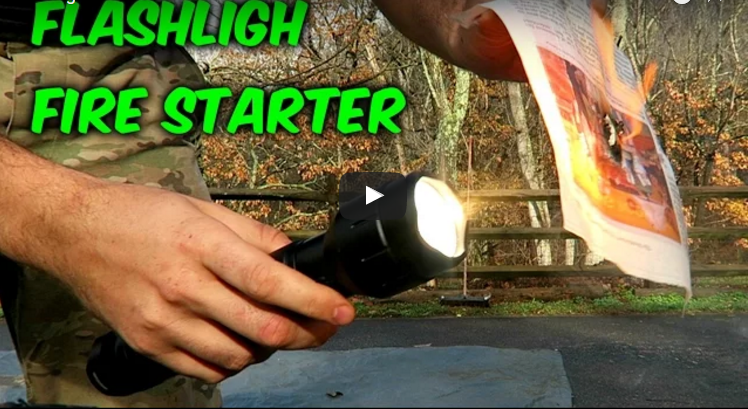
The Flashtorch’s bulb is not a LED like a majority of today’s high-end flashlights, but a filament-based 100W halogen, estimated to last for 2000 hours of use. It is truly amazing how much heat that little bulb can generate. Surrounding the halogen bulb is a high efficiency reflector that funnels the light into a more concentrated beam. The base of the flashlight has an on/off switch to help ensure that it is not inadvertently switched on.
The flashlight has an LED illuminated power level switch just below the head of the flashlight. The Flashtorch has three power settings: high / medium / low. On a fully charged battery (3000 mAh), low (30% power) will last 80 minutes, medium (50% power) will last 50 minutes, and high (100% power/4100 lumens) will last 20 minutes. It is a definite improvement over the original Torch that would only last a measly 5 minutes on maximum. The 3000 mAh battery is a $50 upgrade to the standard 1500 mAh battery the Torch usually ships with.
To strap on and run with the Bionic Boots is a feeling like no other. As you begin to stride, you feel the springs storing energy. Then you push off, and you feel the enormous power released, akin to acquiring your own slice of a superpower.
I built the Bionic Boots simply because I wanted that experience. Ever since I was 12 years old, I’ve been dreaming of one day dropping into the African savanna and running with cheetahs.
Initially, the concept was to emulate and experience the sensation and speed of running like a fast animal. I still have the same goal, but the invention is evolving through the use of future technologies to reach new endeavors. I want to produce a viable form of environmentally sound transportation over any terrain, be it city streets or off-road trails — and to run faster than any man alive.
The first spark of inspiration came from watching a natural history program on kangaroos and how they were able to store energy in their large Achilles tendons, enabling them to move at high speed over difficult terrain with an efficient gait. I made my first drawings at 12, and the inventions that came along years later were not too dissimilar to those originals.
A quarter century later, I’m on something like the 200th prototype. These boots are made from aluminum and carbon fiber, with elastic tendons. In them, I stand 7 feet tall, and can run 25 mph.
In the intervening time, I went to college and moved, in 1999, to America. I studied transport design and won a Royal Society for the Arts award for the boots, and used that grant to go to California, the birthplace of so many recreational sports (mountain bikes, skateboards, fiberglass surfboards) and to bring the Bionic Boot into the public domain.
I already had an aesthetically pleasing and working prototype, but it would be one of many. I tend bar six days a week to pay for patent fees and material costs and have worked up to the X14 .
The boots work by basically giving plantigrade (that is, flat-footed) humans a mechanical advantage, allowing them to run on their toes in digitigrade fashion, the way fast land mammals such as greyhounds and cheetahs do. By raising me on my toes, the boots lengthen my legs and stride, which increases speed and efficiency.
There are two levers, a main one and one for the toes. Both are attached to rubber extension springs that mimic the aforementioned kangaroo tendons. The main lever provides the majority of the propulsive force. As the boot lands, the 18-inch lever stretches the springs; then as they contract, the lever swings through a pivot past the heel, propelling the main lever and springing the user like a catapult. The smaller toe lever has a rubber and foam grip, which gives purchase over uneven terrain. Depending on the conditions, one, two, or possibly three interchangeable toes with differing sizes and tread patterns can be added.
To build the boots, I leveraged metalwork, carbon-fiber molding, and spring building. The initial main boot was designed and constructed by making an anatomically correct copy of the boot itself. Later, my friend Carl Riccitelli made a mold of it, and laid carbon fiber into the mold to produce the current prototype with the best strength-to-weight ratio so far.
Aircraft grade aluminum (6061 and 7000 series) was used for the other major components. All were constructed without the use of CNC milling machines or casting methods, but instead were cut, shaped, and polished using only a hand drill, angle grinder, and hacksaw.
The spring system is made of natural rubber from speargun spring bands, cut to specific length, with custom-made grommets to attach to the rubber. These can be added or subtracted to adjust for the weight of different users or the running style or cadence desired.
My invention has been designed — and has evolved — for fast running as a form of transportation. While the top speed is formidable, the stilts are not designed for maneuverable running (i.e. turning).
I am not the only inventor to design augmenting boots. There are other proto-types and products that use different spring systems, though my invention pre-dates the patents on the most similar ones.
One example, originally sold as Powerbocks (now Pro-Jumps) from Germany, also uses a pivoted lever to add stability, but is designed more like traditional stilts, allowing you to jump vertically like a pogo stick. Young athletes use them for parkour-style extreme sports. (Not to be confused with kids’ springy Moon Shoes, which simply suspend the feet in oval frames, like two trampolines.)
The differences between the two are not only in the main function but also in the spring: The Pro-Jumps use a fiberglass leaf spring, whereas mine feature natural rubber as an extension spring to store potential energy. Additionally, because of the material, the Bionic Boots weigh in at just six pounds, around two pounds less than the Pro-Jumps.
But one feature that is truly unique is the pivoted toe, which gives the landing some dampening from the stiff impact of the large spring, as well as maneu-verability and extra purchase on uneven terrain. I’ve used them on everything from potholed and cobblestoned streets in New York and London to California beaches, peaks in the Rocky Mountains, and even in shallow water.
There’s still a lot to do, future improvements to the Bionic Boot to extend the distance and speed. I’m planning an onboard electronic feedback control system to help coordinate the power and propulsion to give the most effective timing of power output throughout the running cadence, thus providing maximum efficiency and power expenditure. I’d also like to explore 3D printing, specifically with titanium or carbon fiber — even a 10 percent weight reduction could give incredible results.
Collaboration with companies like Local Motors, which printed a car with carbon fiber-infused ABS, or Renishaw, which printed a titanium bicycle, could help improve the boots’ performance.
The “muscles” could be adapted too, perhaps to include pneumatics like Festo’s “fluidic muscle,” which enabled that company’s Bionic Kangaroo. It uses pneumatic pressure to contract the muscle as air is added. In nature, a kangaroo recovers energy from jumping and stores it for the next leap. In a boot, that could mean greatly increased speed and distance.
In the end, the Bionic Boots could become a whole interlinked exoskeleton built solely for speed, approaching that of an ostrich or even a cheetah.
I can see a vision of a prototype I sketched many years ago, encompassing a full-powered protective suit with onboard readouts of speed, distance, system power outputs, and more. It’s my bionic conception of future transportation.
I built the Bionic Boots simply because I wanted that experience. Ever since I was 12 years old, I’ve been dreaming of one day dropping into the African savanna and running with cheetahs.
Initially, the concept was to emulate and experience the sensation and speed of running like a fast animal. I still have the same goal, but the invention is evolving through the use of future technologies to reach new endeavors. I want to produce a viable form of environmentally sound transportation over any terrain, be it city streets or off-road trails — and to run faster than any man alive.
The first spark of inspiration came from watching a natural history program on kangaroos and how they were able to store energy in their large Achilles tendons, enabling them to move at high speed over difficult terrain with an efficient gait. I made my first drawings at 12, and the inventions that came along years later were not too dissimilar to those originals.
A quarter century later, I’m on something like the 200th prototype. These boots are made from aluminum and carbon fiber, with elastic tendons. In them, I stand 7 feet tall, and can run 25 mph.
In the intervening time, I went to college and moved, in 1999, to America. I studied transport design and won a Royal Society for the Arts award for the boots, and used that grant to go to California, the birthplace of so many recreational sports (mountain bikes, skateboards, fiberglass surfboards) and to bring the Bionic Boot into the public domain.
I already had an aesthetically pleasing and working prototype, but it would be one of many. I tend bar six days a week to pay for patent fees and material costs and have worked up to the X14 .
The boots work by basically giving plantigrade (that is, flat-footed) humans a mechanical advantage, allowing them to run on their toes in digitigrade fashion, the way fast land mammals such as greyhounds and cheetahs do. By raising me on my toes, the boots lengthen my legs and stride, which increases speed and efficiency.
There are two levers, a main one and one for the toes. Both are attached to rubber extension springs that mimic the aforementioned kangaroo tendons. The main lever provides the majority of the propulsive force. As the boot lands, the 18-inch lever stretches the springs; then as they contract, the lever swings through a pivot past the heel, propelling the main lever and springing the user like a catapult. The smaller toe lever has a rubber and foam grip, which gives purchase over uneven terrain. Depending on the conditions, one, two, or possibly three interchangeable toes with differing sizes and tread patterns can be added.
To build the boots, I leveraged metalwork, carbon-fiber molding, and spring building. The initial main boot was designed and constructed by making an anatomically correct copy of the boot itself. Later, my friend Carl Riccitelli made a mold of it, and laid carbon fiber into the mold to produce the current prototype with the best strength-to-weight ratio so far.
Aircraft grade aluminum (6061 and 7000 series) was used for the other major components. All were constructed without the use of CNC milling machines or casting methods, but instead were cut, shaped, and polished using only a hand drill, angle grinder, and hacksaw.
The spring system is made of natural rubber from speargun spring bands, cut to specific length, with custom-made grommets to attach to the rubber. These can be added or subtracted to adjust for the weight of different users or the running style or cadence desired.
My invention has been designed — and has evolved — for fast running as a form of transportation. While the top speed is formidable, the stilts are not designed for maneuverable running (i.e. turning).
I am not the only inventor to design augmenting boots. There are other proto-types and products that use different spring systems, though my invention pre-dates the patents on the most similar ones.
One example, originally sold as Powerbocks (now Pro-Jumps) from Germany, also uses a pivoted lever to add stability, but is designed more like traditional stilts, allowing you to jump vertically like a pogo stick. Young athletes use them for parkour-style extreme sports. (Not to be confused with kids’ springy Moon Shoes, which simply suspend the feet in oval frames, like two trampolines.)
The differences between the two are not only in the main function but also in the spring: The Pro-Jumps use a fiberglass leaf spring, whereas mine feature natural rubber as an extension spring to store potential energy. Additionally, because of the material, the Bionic Boots weigh in at just six pounds, around two pounds less than the Pro-Jumps.
But one feature that is truly unique is the pivoted toe, which gives the landing some dampening from the stiff impact of the large spring, as well as maneu-verability and extra purchase on uneven terrain. I’ve used them on everything from potholed and cobblestoned streets in New York and London to California beaches, peaks in the Rocky Mountains, and even in shallow water.
There’s still a lot to do, future improvements to the Bionic Boot to extend the distance and speed. I’m planning an onboard electronic feedback control system to help coordinate the power and propulsion to give the most effective timing of power output throughout the running cadence, thus providing maximum efficiency and power expenditure. I’d also like to explore 3D printing, specifically with titanium or carbon fiber — even a 10 percent weight reduction could give incredible results.
Collaboration with companies like Local Motors, which printed a car with carbon fiber-infused ABS, or Renishaw, which printed a titanium bicycle, could help improve the boots’ performance.
The “muscles” could be adapted too, perhaps to include pneumatics like Festo’s “fluidic muscle,” which enabled that company’s Bionic Kangaroo. It uses pneumatic pressure to contract the muscle as air is added. In nature, a kangaroo recovers energy from jumping and stores it for the next leap. In a boot, that could mean greatly increased speed and distance.
In the end, the Bionic Boots could become a whole interlinked exoskeleton built solely for speed, approaching that of an ostrich or even a cheetah.
I can see a vision of a prototype I sketched many years ago, encompassing a full-powered protective suit with onboard readouts of speed, distance, system power outputs, and more. It’s my bionic conception of future transportation.